
Maintenance
Repairs
Step 1: Whose responsibility is it?
Your contract should set out who is responsible for different repairs or odd-jobs around your rented flat or house.
The law also implies various duties on landlords to keep the property safe and in good repair.
It is not always easy to determine exactly who is responsible for certain repairs. Your rights and responsibilities may vary depending on the type of letting agreement that is in place. Seek advice from a Housing Advisor if you are not sure about the situation in your rented flat or house.

Landlord’s responsibilities
- In general: the big things!
- Heating and hot water supply
- Basins, sinks, baths and toilets
- Structure of the property including windows, external doors, drains and gutters
- Gas appliances (boiler, cooker)
- Fixed electrical installations (wiring, electrical sockets and fittings)
Tenant’s responsibilities
- Report repair issues to the landlord or managing agent
- Change light bulbs
- Test smoke alarms periodically, and changing the batteries if required
- Keep the property (and the garden, if there is one) clean and in good order
Step 2: Report it
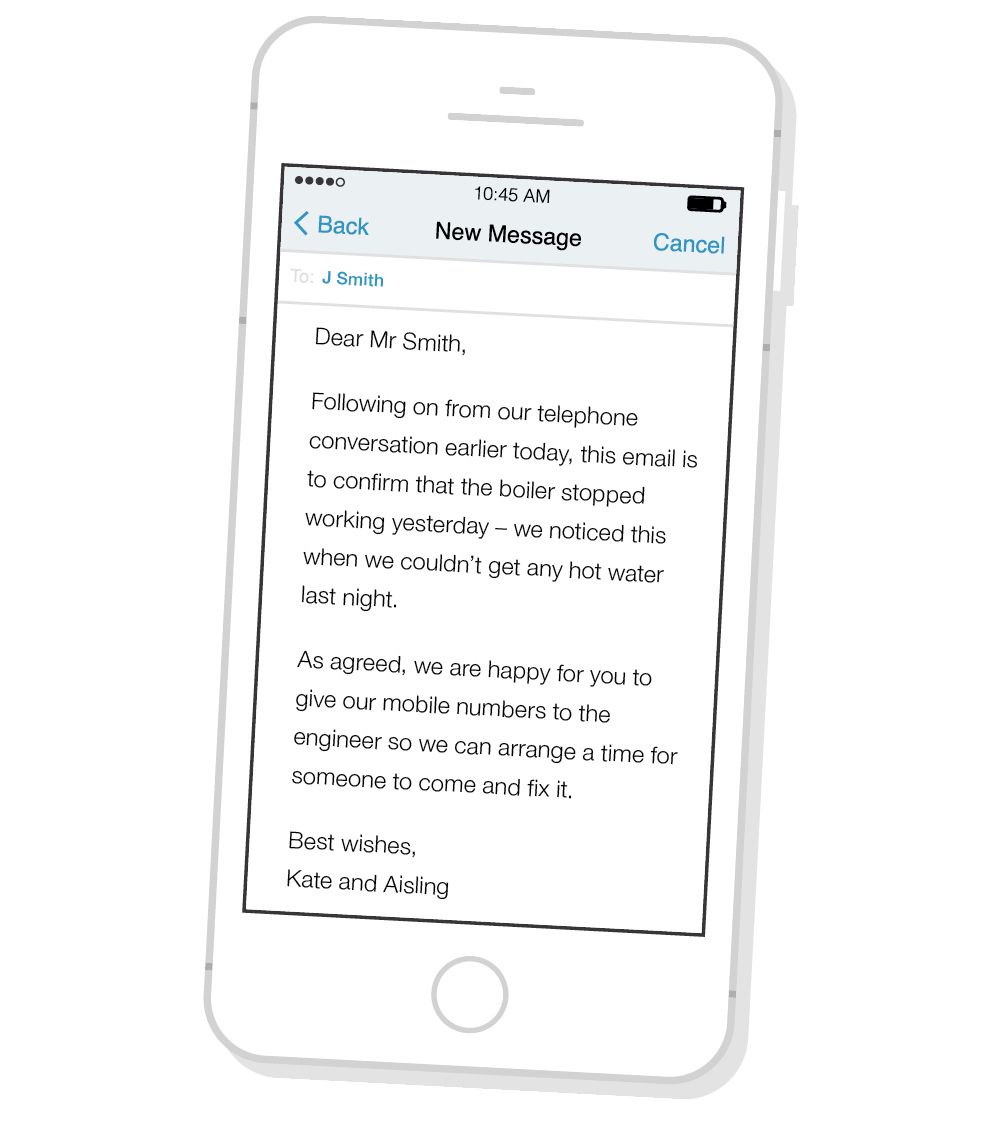
- In writing – a simple email is best
- If you report something by telephone or in person, follow-up with an email to confirm what you discussed
- Report the details that are relevant:
– What has stopped working?
– When did it stop working?
– Is it affecting anything else in the flat? - Keep a record of any emails or messages sent and received
- Keep back-up copies of photos and other important files
- Keep notes of relevant dates and events, such as:
– Appointments arranged for the landlord or an engineer to visit the property
– Any diagnosis of the problem from an engineer
– Estimates of how long it will take to fix the problem, order parts etc.
– The date on which each problem is finally resolved
How long should it take for a problem to be fixed?
A landlord should fix problems in your rented property within a reasonable time. What is ‘reasonable’ will vary depending on the circumstances. If you think things are taking too long and are not sure of how to proceed, you should seek advice.
Step 3: Follow-up
What if the problem does not get fixed?
- If your landlord is not seeing to repairs within a reasonable time (or at all) they may be in breach of the tenancy agreement and their legal obligations. You may also have a claim for compensation
- It might help to:
– Write a follow-up letter
– Seek advice from a Housing Advisor, who may be able to write to the landlord on your behalf - Contact your local council (find the department on their website that deals with private rented accommodation)
Can I move out if the problems do not get fixed?
- Not usually. You should seek advice about your situation before you take any action
- It might be possible to agree with the landlord for an early termination of the tenancy (otherwise known as a ‘surrender’). See our leaving early section for more information

Can I withhold rent?
- This is not usually advised
- Your obligation to pay rent is separate from the landlord’s obligation to carry out repairs
- Your landlord could evict you if you withhold rent, even if there are repairs to be done
- Seek further advice about your situation from a Housing Advisor before taking action
Can my landlord evict me if I report repairs?
- This is known as ‘revenge eviction’
- A landlord can usually bring a tenancy to an end by serving a section 21 notice, but not during the fixed term
- If you have an assured short hold tenancy (AST) that started on or after 1 October 2015 or assured periodic tenancy (APT), then you have some extra protection against ‘revenge evictions’
- Seek advice straight away if you have reported repairs to the landlord but have been given a notice to leave the property before the repairs have been carried out

Can I do the repairs myself?
- It is very risky for tenants to take on repairs themselves, even if directly employing a contractor. You would be responsible for any defects in the work and the landlord may be unwilling to reimburse you for the money you have spent
- Always get the landlord’s written permission before carrying out any work at the property


Where to get more detailed guidance on repairs
Seek advice from a Housing Advisor at the University of London Housing Services or find out more about repairs by visiting Shelter.


Damp and mould
You might have a problem with damp or mould in your home if there are:
- Musty smells
- Dark or discoloured patches on walls or ceilings
- Evidence of mould growth
It is not always easy to identify the cause of a damp and mould problem and, in turn, who is responsible for fixing it.
Damp and mould might be a result of:
- Condensation due to poor ventilation
- Lack of insulation of the property
- Leaking pipes
- Rain water coming in through cracks in the roof or external walls
- Blocked guttering or drains which are overflowing
- Water rising from the ground due to inadequate damp-proofing
Things that tenants can do to tackle condensation and reduce the risk of mould growth include:
- Wiping down condensation you see on walls and windows
- Check that extractor fans are working correctly
– Test an extractor fan by holding a piece of paper over it. If the fan holds the paper in place, then it is likely to be working well
– If the extractor fan is not working, report this to your landlord - Keeping the property adequately heated and ventilated
Report it
If you experience problems with damp or mould you should report it to your landlord.
You might find that landlords or agents are quick to put the blame on the tenants and their use of the property as being the cause of the problem, so make sure you let them know:
- Steps you have taken to tackle the condensation
- Size and location of any damp patches on walls or ceilings
- Any changes or updates to the situation, especially if the mould problem begins to get worse
- Take photos of the issue and send them to your landlord (keep the photos for your records too)
Infestations
No one likes the idea of mice, rats or other pests in their home. If you identify a problem, you should concentrate on two main points:
How do I get rid of them?
Many Councils provide services for treating rodent or insect problems through their Environmental Health departments. Some Councils help to address rat problems free of charge.
Supermarkets and hardware stores usually sell traps or treatments to help tackle problems.
Private pest control companies are more expensive than shop-bought treatment methods, but will generally be more effective. Check your Council’s website to see if they offer a cheaper service.
How do I stop more of them from coming into my home?
What the landlord can do:
- Blocking or filling in any holes or gaps through which mice or rats can gain entry. If a hole in a wall or floor is a result of disrepair, then this is the landlord’s responsibility
What tenants can do:
- Make sure the property is kept in a clean condition
- Empty the rubbish bin regularly and do not leave food lying around
- Report problems to the landlord as soon as they arise
Who is responsible?
It can be difficult to determine who is responsible for getting rid of an infestation. Generally, if a problem is present from the start of the tenancy, it would be the responsibility of the landlord. However, if the problem only occurred after the tenants have been living there for a few months, it may be difficult to prove that they did not cause or contribute to the problem.
Seek advice if you are unsure of where the responsibility lies.
Bed bug warning
Bedbugs are increasingly becoming a problem in large cities like London. You should seek advice straight away if you move into a property that is infested with bed bugs. A delay in seeking advice might limit your options for resolving the situation.
SECTION: Safety
SECTION: Landlords
 Built with Shorthand